
Search has changed. If you have ever Googled something and received a direct answer at the top of the page without clicking a single link, you have already seen Answer Engine Optimization in action. That block at the top is called a Google AI Overview, and it is powered by Google’s Gemini model. It pulls from content across the web, synthesizes it, and delivers one authoritative response.
The businesses that show up in those answers are not there by accident. They have structured their content and online presence in a way that AI tools recognize, trust, and reference. That process has a name: Answer Engine Optimization, or AEO.
This guide breaks down what AEO actually means, why it matters for business owners right now, and the five pillars you need to understand to stay visible as search continues to evolve.
What Is Answer Engine Optimization (AEO)?
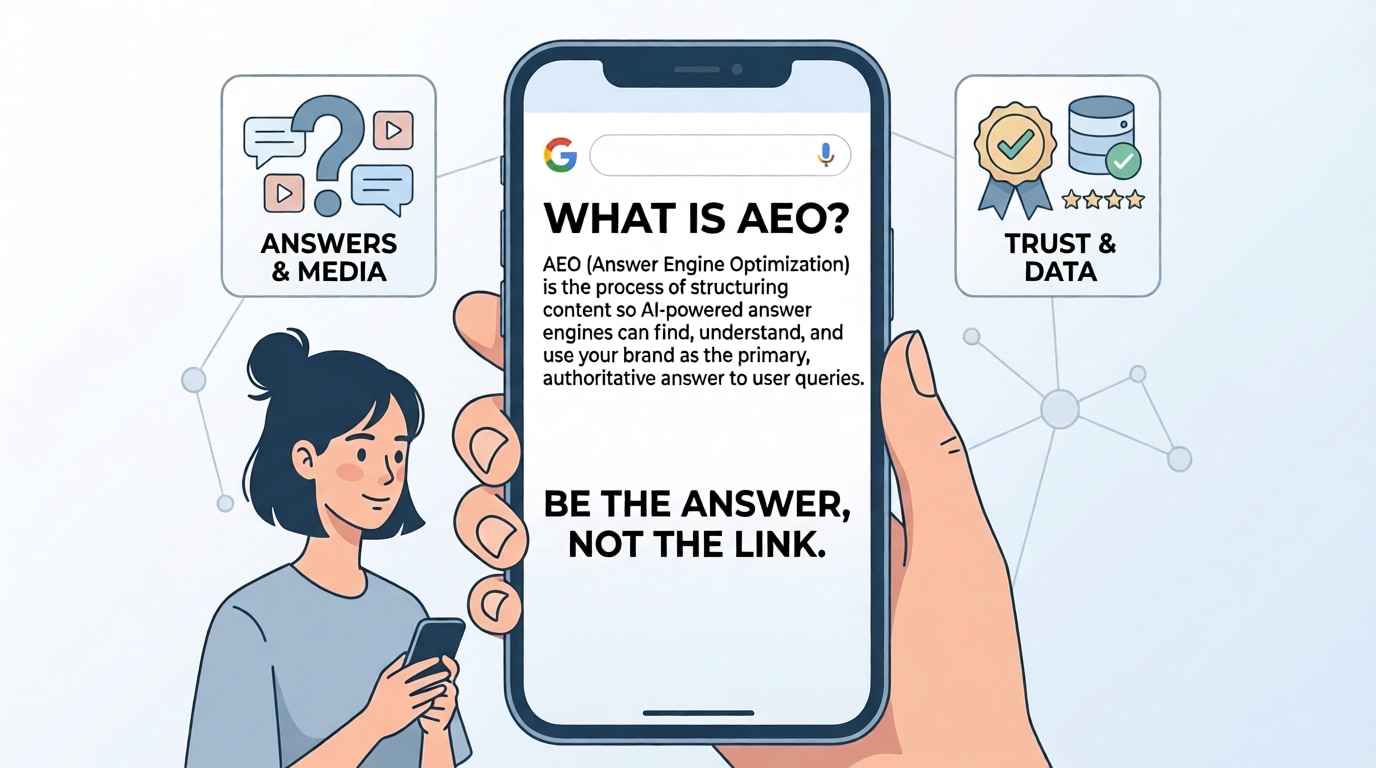
Answer Engine Optimization is the practice of structuring your content and online presence so that AI-powered tools like Google AI Overviews, ChatGPT, and Perplexity can find, understand, and cite your business as an authoritative answer.
Traditional SEO was about ranking links. AEO is about being the answer. The goal shifts from getting someone to click on your website to having your brand referenced when someone asks a question relevant to your business.
| Think of it this way: SEO gets you traffic. AEO gets you cited. Both matter, and the good news is they overlap significantly. The fundamentals of strong SEO are the same foundation AEO is built on. |
AEO vs. SEO: What Is the Difference?
The core distinction comes down to what you are optimizing for. SEO targets a search algorithm to rank a link. AEO targets an AI system to recognize your brand as a credible entity and reference it in a generated answer. You may never get the click. But your brand name, your expertise, and your recommendation can show up in front of exactly the right person at exactly the right moment.
According to research from Ahrefs, visitors who arrive from AI-powered search convert at a rate 23 times higher than traditional organic search visitors. Lower volume, dramatically higher intent.
Why AEO Matters for Your Business Right Now
Google AI Overviews now appear on a significant percentage of all searches. When they do, users click through to traditional results about half as often as they normally would. That means if your content is not structured to be cited, you are losing visibility not because your rankings dropped but because the rules changed.
Search queries are also getting longer and more conversational. Research from Moz and Ahrefs shows that the average search query has nearly doubled in length as users phrase searches the way they would ask a question out loud. If your content does not answer those specific questions directly, AI will find someone else’s content that does.
The businesses winning in AI-powered search right now share a few things in common. They answer questions clearly and early. They are talked about in credible places. They have strong reviews. And their content is structured in a way that machines can easily parse.
The 5 Pillars of AEO: What Actually Works
The following framework is based on a year of live testing by Target Internet’s Digital Marketing Podcast and reinforced by research from HubSpot, Moz, Ahrefs, and other industry sources. These are not theories. They are proven tactics that improve visibility in both AI-powered results and traditional organic search.
| Pillar | What It Involves | Why It Matters to AI |
|---|---|---|
| 1. Question-Led Content | Blog posts, service pages, FAQs | AI surfaces content that directly answers specific questions |
| 2. Entity Reputation | Digital PR, media mentions, listings | LLMs measure credibility by where your brand is referenced |
| 3. Sentiment & Social Proof | Reviews, testimonials, responses | AI uses sentiment data to decide if your brand is recommendable |
| 4. Multimodal Content | Video, audio, images + transcripts | Google now weighs multi-format signals, not just text |
| 5. Structured Data | Schema markup, FAQPage, HowTo | Removes ambiguity so AI can parse and cite your content accurately |
Pillar 1: Question-Led Content
AI surfaces content that directly answers specific questions. That means your blog posts, service pages, and FAQs need to be built around the exact questions your potential customers are asking.
Use the inverted pyramid approach: answer the question in the first paragraph, then provide the supporting detail. Do not bury the answer in the middle of a long article. AI tools scan for direct responses, and so do the humans reading them.
- Frame every piece of content around a real question your audience asks
- Include an FAQ section on every key service or blog page
- Write questions the way a real person would type or say them, not keyword strings
- Mark up FAQ sections with FAQPage schema so AI can parse them easily
Pillar 2: Entity Reputation
This is the biggest shift from traditional SEO thinking. It is no longer just about who links to you. It is about where your brand is mentioned, in what context, and how consistently those mentions connect your business to the right topics.
Google and large language models build what is called a knowledge graph, which maps relationships between brands, topics, and entities. The more your business is mentioned in relevant, credible contexts across the web, the stronger your entity reputation becomes and the more likely you are to be cited as an answer.
- Pursue coverage in industry publications, local media, and relevant online directories
- Optimize your Wikipedia and Wikidata presence if your business qualifies
- Focus on earning mentions, not just links. A brand reference on an authority site still signals relevance to AI systems
- For South Florida businesses: local press, chamber features, and industry association mentions all contribute
Pillar 3: Sentiment and Social Proof
Large language models analyze millions of reviews, forum comments, and social mentions to evaluate whether a business should be recommended. Negative sentiment or an absence of reviews actively reduces your chances of being cited.
This is especially important for service businesses. A medspa, law firm, dental practice, or contractor that has consistent, positive third-party reviews is signaling to AI exactly the kind of credibility it looks for.
- Set up an automated review request process post-service or post-transaction
- Respond to all reviews, including negative ones, promptly and professionally
- Do not just count stars. The text of your reviews matters. Specificity, service descriptions, and location references all reinforce your entity reputation
- Monitor your brand mentions across Google, Yelp, Facebook, and industry-specific platforms
Pillar 4: Multimodal Content
Google’s AI systems now evaluate signals across text, video, audio, and images. If your content strategy is text-only, you are missing a significant share of the visibility signals that Google weighs when selecting AI Overview sources.
The good news is that multimodal does not mean producing entirely new content from scratch. It means repurposing what you already create into multiple formats.
- Pair key blog posts and service pages with a short, explanatory YouTube video
- Upload manual SRT transcript files to YouTube videos for better indexing
- Repurpose blog content into Instagram carousels, LinkedIn posts, and short-form video
- Add alt text to all images and name image files descriptively before uploading
At Brand Growth Studio, the multi-format content strategy we build for clients is designed specifically with this in mind. A blog post becomes a GBP post, a carousel, a video script. Each format strengthens the overall search footprint.
Pillar 5: Structured Data and Schema Markup
Schema markup is code added to your website that tells search engines and AI tools exactly what kind of content they are looking at. It removes ambiguity. It helps Google understand whether a page is a product, a service, a how-to guide, an FAQ, or a local business profile.
This is one of the highest-return website development optimizations available right now, as it enhances both user experience and performance, improving visibility in AI-driven results as well as traditional search click-through rates.
- Add schema to your most important pages: LocalBusiness, Article, FAQPage, HowTo, Service, and Author
- Use Google’s Rich Result Test to validate your markup
- Reference schema.org for documentation on every available schema type
- If you work with an SEO team, make sure schema implementation is part of their standard deliverable
AEO and SEO Work Together
| You do not need to choose between SEO and AEO. The tactics that make content visible to AI are the same tactics that make content rank well in traditional search. Strong fundamentals compound. |
Content that answers real questions clearly. A business that earns credible mentions across the web. Positive reviews and an active online presence. Structured data that helps machines understand what you do. These are not new ideas. AEO makes them more important than they have ever been.
The businesses that invest in this now will have a significant advantage as AI-powered search continues to grow. The ones that wait will find themselves invisible in an increasingly answer-driven world.
Frequently Asked Questions About Answer Engine Optimization
Do I need to completely redo my SEO strategy to optimize for AI search?
No. AEO builds on top of existing SEO fundamentals. If you have already invested in quality content, keyword research, and technical optimization, you are ahead of the curve. The key upgrades are adding FAQ sections, pursuing brand mentions, and implementing schema markup on key pages.
What types of businesses benefit most from AEO?
Any business that relies on being found online stands to benefit. Service businesses like law firms, medical practices, contractors, and agencies are particularly well-positioned because their clients typically search with high-intent questions before making a hiring decision. Local businesses in competitive South Florida markets like Boca Raton, Ft. Lauderdale, and Coral Springs benefit from the combination of AEO and local SEO working together.
How do I know if my business is showing up in Google AI Overviews?
Search for the specific questions your customers ask about your service category and location. Look at the AI Overview panel at the top of the results. Track whether your business, your content, or your brand name appears. You can also use tools like HubSpot’s AI Search Grader to assess your current AI visibility.
Is AEO the same as GEO or LLM optimization?
These terms are often used interchangeably. AEO (Answer Engine Optimization), GEO (Generative Engine Optimization), and LLMO (Large Language Model Optimization) all refer to similar strategies. AEO emphasizes the answer-focused nature of the goal, which is to be cited as the response rather than simply ranked as a link.
How long does it take to see results from AEO?
AEO results vary depending on how strong your existing SEO foundation is, how competitive your market is, and how quickly you implement the five pillars. Some businesses see AI Overview appearances within weeks of structured content updates. Building entity reputation through mentions and reviews is a longer-term effort. Expect meaningful progress over three to six months with consistent execution.
Ready to Show Up in AI-Powered Search Results?
Brand Growth Studio helps businesses across South Florida build the kind of online presence that gets cited, not just ranked. From Google Business Profile optimization and local SEO to content strategy and schema implementation, we manage the full picture so your business stays visible as search continues to evolve.
If you want to know where your business stands in AI-powered search today, let’s talk.
Contact Brand Growth Studio for a complimentary strategy consultation.